Japan travelers can choose from an eSIM, a physical SIM card, Pocket WiFi or international roaming. None of these options is automatically best for everyone.
The right choice depends on the phone you carry, whether you travel alone or in a group, how much data you use, whether you need a Japanese phone number and how comfortable you are changing mobile settings.
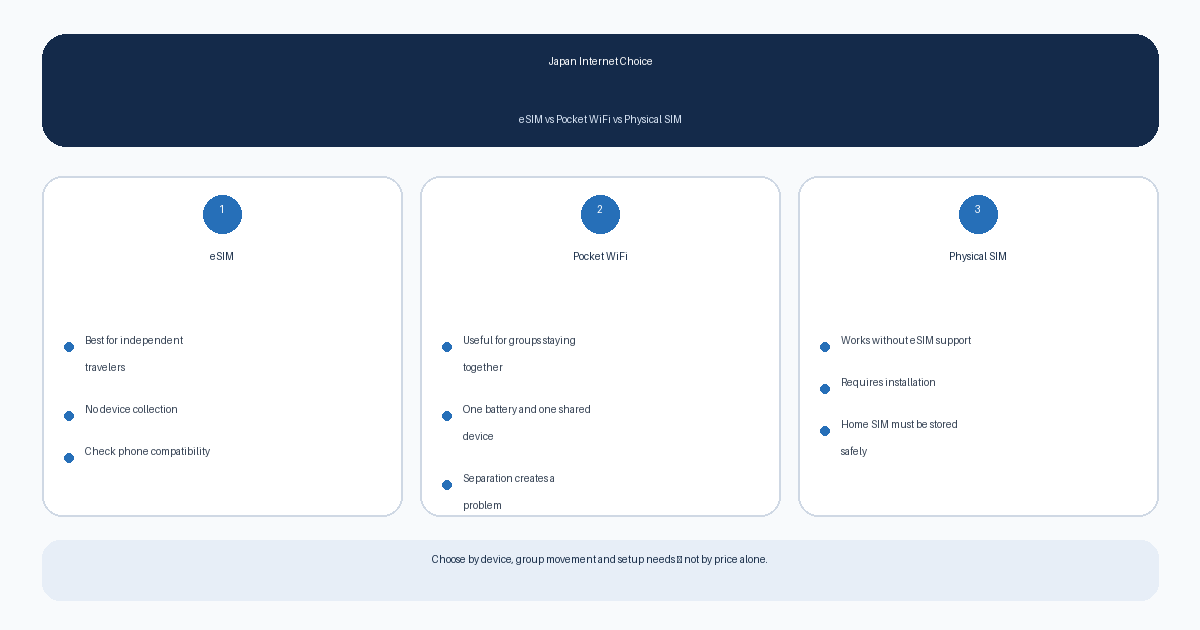
Quick answer: An eSIM is usually the simplest choice for one traveler with an unlocked, compatible phone. Pocket WiFi can work better for a group that stays together. A physical SIM may suit a compatible phone without eSIM support. Home-carrier roaming is convenient but should be checked carefully for total cost.
- Fast comparison
- Choose an eSIM when these conditions fit
- Choose Pocket WiFi when several devices must connect
- Choose a physical SIM when eSIM is unavailable
- Use home-carrier roaming only after checking the full cost
- Decision table by traveler type
- Group travel: one Pocket WiFi or separate eSIMs?
- Data-only service or Japanese phone number?
- What “unlimited” may not tell you
- Compare total cost, not only the displayed price
- Setup and arrival differences
- Common mistakes
- Final checklist
- Official checks before choosing eSIM, SIM card or Pocket WiFi
- Related guides
- Bottom line
Fast comparison
| Option | Best suited to | Main advantage | Main drawback |
|---|---|---|---|
| eSIM | Solo travelers with a compatible unlocked phone | No device pickup or physical SIM swap | Requires eSIM support and correct phone settings |
| Pocket WiFi | Families and groups staying together | Several devices can share one connection | Must be charged, carried and returned |
| Physical SIM | Phones without eSIM support | Works with many unlocked SIM-compatible phones | Requires SIM replacement and safe storage of the home SIM |
| International roaming | Short stays where convenience matters more than price | Keeps the normal SIM and phone number active | Total cost and data limits vary by home carrier |
Choose an eSIM when these conditions fit
An eSIM is a strong starting point when:
- you travel alone;
- your exact phone model supports eSIM;
- the phone is carrier-unlocked;
- you mainly need maps, messages, browsing and app-based calls;
- you do not need to collect or return a device;
- you are comfortable checking mobile-data and roaming settings.
Installation can usually be completed before departure while connected to reliable WiFi. After arrival, the travel eSIM is selected as the mobile-data line.
Before buying, confirm when the plan’s validity begins, whether tethering is allowed and whether the plan is data-only. Our Japan eSIM selection guide provides a complete purchase checklist.
Choose Pocket WiFi when several devices must connect
Pocket WiFi is a small portable router. It connects to a mobile network and shares the connection over WiFi.
It can be useful when:
- a family or group stays together most of the day;
- several phones, tablets or laptops need internet;
- some devices do not support eSIM;
- travelers do not want to change SIM settings;
- laptop use is more important than receiving calls on a Japanese number.
The biggest practical issue is that the group depends on one device. When the person carrying the router separates from the others, everyone else loses the shared connection.
You must also consider charging, battery life, pickup, return deadlines, loss charges and whether the plan reduces speed after heavy use.
Choose a physical SIM when eSIM is unavailable
A physical travel SIM can be suitable when the phone is unlocked but does not support eSIM.
Check the required SIM size, supported network bands, activation instructions and whether the product is data-only. Keep the original SIM in a secure place during the trip.
A physical SIM does not automatically provide a Japanese phone number. Many tourist SIM products are data-only, just like travel eSIMs.
Use home-carrier roaming only after checking the full cost
International roaming is convenient because the existing SIM remains active. It can also make it easier to receive messages sent to the home number.
Before relying on roaming, check:
- the daily or trip-wide charge;
- the included high-speed data;
- what happens after the allowance is used;
- whether calls and SMS cost extra;
- whether accidental roaming can continue after the package ends;
- whether hotspot use is included.
A short advertised daily price may become expensive when multiplied across a longer stay.
Decision table by traveler type
| Traveler type | Likely starting option | Reason |
|---|---|---|
| Solo traveler for one or two weeks | eSIM | Simple setup with no pickup or return |
| Family that stays together | Pocket WiFi or separate eSIMs | Compare one shared connection with independent access |
| Friends who often separate | Separate eSIMs or SIM cards | Each person keeps internet access |
| Traveler with an older phone | Physical SIM or Pocket WiFi | eSIM may not be supported |
| Remote worker | Large-data eSIM plus backup, or Pocket WiFi | Hotspot rules and backup access matter |
| New resident needing a Japanese number | Voice/SMS-capable mobile plan | Travel data products may not provide a number |
| Very short stay with a good roaming package | Home-carrier roaming | May be worth paying for simplicity |
Group travel: one Pocket WiFi or separate eSIMs?
Do not compare only the headline price. Compare how the group will actually move.
| Question | Pocket WiFi may fit | Separate eSIMs may fit |
|---|---|---|
| Will everyone stay together? | Usually yes | Not necessary |
| Will people split up for shopping or activities? | Can become inconvenient | Each person stays connected |
| How many devices need access? | One router can serve several devices | Each plan usually serves its own phone and permitted hotspot devices |
| Who handles charging? | One person manages the router | Each traveler manages their own phone |
| What happens if a device is lost? | The whole group may lose internet | Only one traveler is affected |
Data-only service or Japanese phone number?
Many travel eSIMs, physical SIMs and Pocket WiFi rentals provide internet access only. They do not automatically include a Japanese telephone number.
Data-only access is normally enough for:
- Google Maps and train-route applications;
- translation applications;
- LINE, WhatsApp and other internet messaging;
- email and web browsing;
- app-based voice and video calls.
A Japanese number can matter for longer stays, apartment applications, deliveries, employers, schools, banks or services that use SMS verification.
Do not assume that a tourist internet product can later be converted into a normal Japanese mobile contract.
What “unlimited” may not tell you
An unlimited plan may still have conditions involving speed management, hotspot use, daily high-speed allowances or fair-use policies.
Check the current provider page for:
- high-speed data limits;
- speed after heavy use;
- tethering restrictions;
- video-streaming restrictions;
- network-priority conditions;
- refund or cancellation rules.
Heavy users should read the unlimited-data eSIM guide. Remote workers should also review the Japan internet guide for remote work.
Compare total cost, not only the displayed price
The useful comparison is the total cost for the complete trip.
| Cost item | eSIM | Pocket WiFi | Physical SIM | Roaming |
|---|---|---|---|---|
| Plan charge | Usually based on data and validity | Often based on rental days and plan type | Usually one-time or prepaid | Often daily or package-based |
| Delivery or pickup | Normally none | May apply | May apply | None |
| Return requirement | None | Usually required | None | None |
| Loss risk | No separate rental device | Possible replacement charge | Risk of losing the home SIM | No separate device |
| Extra data | Top-up availability varies | Speed or allowance rules vary | Top-up availability varies | Carrier charges vary |
For cost-focused eSIM choices, use the cheap Japan eSIM guide. For five-, ten-, fourteen- or thirty-day trips, use the eSIM guide by trip length.
Setup and arrival differences
eSIM
- Confirm compatibility and carrier-unlocked status.
- Buy and install while connected to WiFi.
- Save activation instructions offline.
- Select the travel eSIM for mobile data after landing.
- Test maps and a webpage before leaving the airport.
Groups that remain together may prefer one shared router instead of buying separate plans for every traveler. The Pocket WiFi guide for Japan group trips explains when sharing works and when each traveler still needs an independent connection.
Pocket WiFi
- Reserve the device and confirm the pickup point.
- Collect it from the airport, hotel or delivery location.
- Connect devices using the supplied WiFi password.
- Charge it daily and keep it with the group.
- Return it by the required deadline.
Travelers choosing a removable SIM should also check the SIM size, APN instructions, loss of access to the home SIM and whether the product is data-only. The physical SIM buying guide for Japan covers those installation checks.
Physical SIM
- Confirm phone unlock status, SIM size and network compatibility.
- Insert the SIM or ask for help at the pickup counter.
- Follow APN or activation instructions.
- Store the home SIM safely.
The airport eSIM setup guide covers checks to complete before leaving the arrivals area.
Common mistakes
- Buying an eSIM before checking the exact phone model.
- Assuming every travel product includes a Japanese number.
- Choosing Pocket WiFi for a group that frequently separates.
- Ignoring the router return deadline.
- Leaving home-SIM data roaming active by accident.
- Installing a short-validity eSIM too early.
- Assuming unlimited data always includes unlimited hotspot use.
- Deleting an eSIM profile before contacting support.
- Comparing only the first displayed price.
When an installed eSIM does not connect, follow the eSIM troubleshooting guide before deleting the profile.
Final checklist
- I confirmed my exact phone supports the option.
- I confirmed the phone is carrier-unlocked.
- I know whether I need a Japanese phone number.
- I compared the total cost for the entire trip.
- I checked data, validity and speed-reduction rules.
- I checked hotspot or tethering conditions.
- I considered whether the group will separate.
- I understand pickup and return requirements.
- I saved setup and support information offline.
- I have a backup plan for arrival.
Official checks before choosing eSIM, SIM card or Pocket WiFi
The three options do not have identical setup requirements. Confirm device support and airport availability through current first-party information before paying.
| Question | Official page to check |
|---|---|
| Can an iPhone use a travel eSIM while retaining another line? | Apple: use eSIM while traveling internationally |
| How is an eSIM added on a Google Pixel? | Google Pixel: set up a new eSIM |
| Where are SIM-card and WiFi services at Narita? | Narita Airport: SIM and WiFi service locations |
| Where are SIM-card and WiFi services at Haneda? | Haneda Airport: mobile, SIM and WiFi services |
Decision rule: Check the exact phone first, then decide whether each traveler needs an independent connection. Airport availability should remain a backup, not a reason to postpone all preparation until arrival.
Related guides
Bottom line
Choose an eSIM for independent, low-friction mobile access on a compatible phone. Choose Pocket WiFi when several devices stay together and sharing is more important than independence. Choose a physical SIM when eSIM is unavailable. Use roaming when the verified total cost is acceptable and convenience is the priority.
The option that fits the trip is more useful than a universal winner.
Last reviewed: July 2026. Prices, networks, device support and provider conditions can change. Confirm current terms before purchasing.