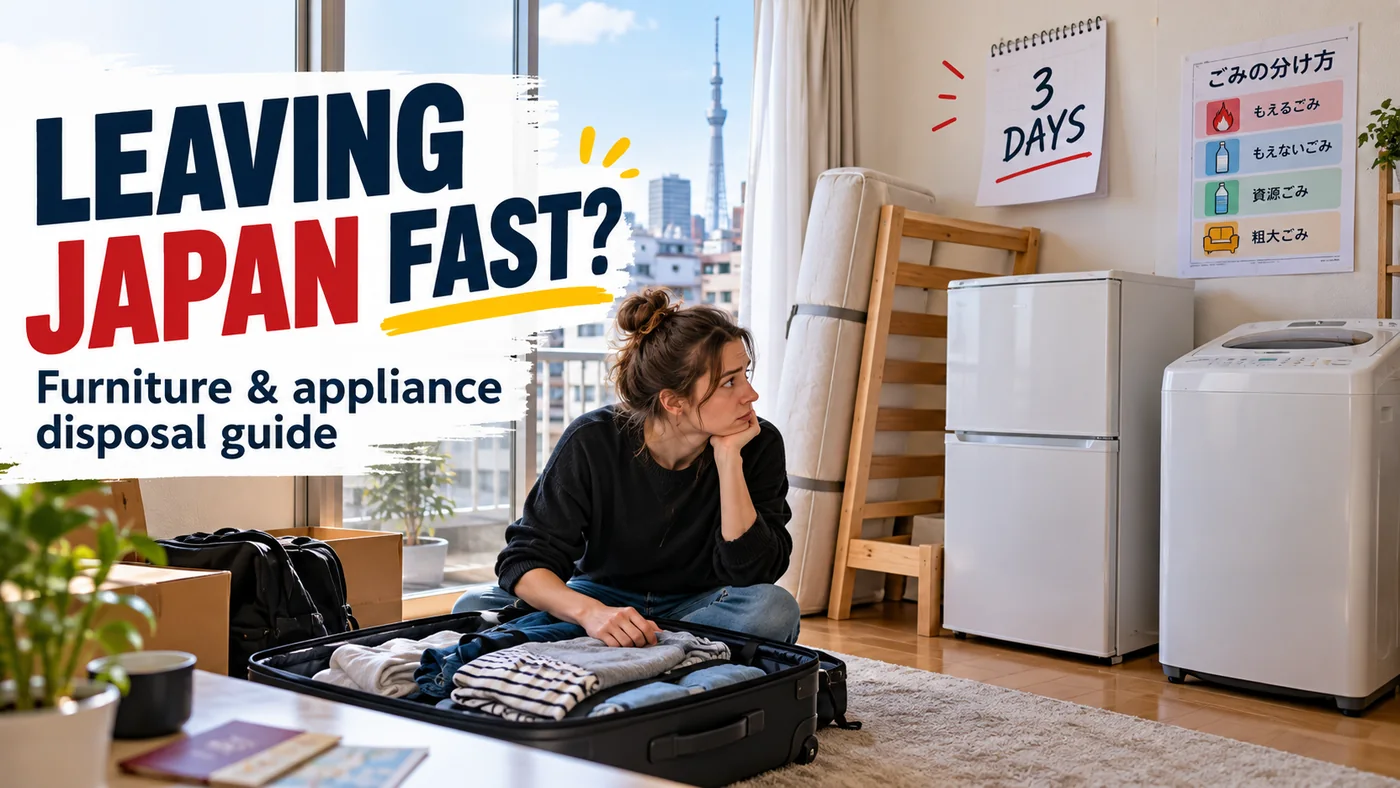
If your flight is close, do not start by searching for “the cheapest junk removal.” First split your items into two groups: ordinary bulky waste such as a bed frame or table, and the four home appliances that follow Japan’s Home Appliance Recycling Law. A refrigerator, freezer, washing machine, clothes dryer, TV or air conditioner can follow a completely different route from ordinary furniture.
[mjhr_moveout_checker]
- The 60-second move-out decision
- Step 1: Separate ordinary bulky waste from the four regulated appliances
- Step 2: Check whether the municipal deadline still fits your flight
- Step 3: For refrigerators and similar appliances, switch routes immediately
- Step 4: If you need paid pickup, check the legal collection route—not just English support
- What to do when you have only 72 hours left
- Avoid the expensive panic mistake
- Leaving Japan fast: the practical order
The 60-second move-out decision
If the city deadline still fits, this is often the first route to check.
These four appliance categories are covered by a separate recycling system.
Use a city-authorized or otherwise legally permitted collection route when municipal timing no longer works.
Step 1: Separate ordinary bulky waste from the four regulated appliances
Japan’s Ministry of Economy, Trade and Industry lists four household-appliance categories under the Home Appliance Recycling Law: air conditioners, televisions, refrigerators/freezers, and washing machines/clothes dryers. These are not simply “big trash.” The collection route depends on the item, retailer and municipality.
That means a bed frame and a refrigerator sitting next to each other in the same apartment may need completely different disposal plans.
Step 2: Check whether the municipal deadline still fits your flight
Bulky-waste systems are local. Do not assume the schedule in Tokyo, Osaka or Sapporo is the same.
Sapporo says bulky waste is collected by paid individual pickup. Applications are accepted from two weeks before the desired collection date, and each ward has a collection weekday and application deadline. The city also states that the four regulated appliances are excluded from bulky waste.
If you are leaving in three days and the next municipal collection slot is after your flight, the “cheap city pickup” answer may no longer be usable. That is exactly why the remaining number of days matters more than a generic list of disposal methods.
Step 3: For refrigerators and similar appliances, switch routes immediately
For a refrigerator, freezer, washing machine, clothes dryer, TV or air conditioner, check the retailer that sold the item, the retailer selling the replacement, or your municipality’s official instructions when the original retailer is unknown. The national guidance specifically tells residents to follow the municipality’s route when the original shop cannot be identified.
Fridge disposal before leaving Japan →
Step 4: If you need paid pickup, check the legal collection route—not just English support
The Ministry of the Environment warns against unlicensed household-waste collectors. For household waste, a general waste collection/transport permit or municipal delegation matters; an industrial-waste permit or secondhand-dealer permit alone is not the same thing.
So “English-speaking” is useful, but it is not the first safety check. Ask the operator how the household waste is legally collected and processed, and compare that answer with your city’s official guidance.
[mjhr_moveout_pr]
What to do when you have only 72 hours left
- Photograph every item. Include a wide shot and a label/model photo for appliances.
- Write the exact deadline. “I must hand over the room by 11:00 on September 28” is more useful than “ASAP.”
- Measure large furniture. Width × depth × height helps both municipal applications and private quotes.
- Separate the four regulated appliances. Do not bundle them into an ordinary bulky-waste request.
- Check your city’s next legal pickup route. If it cannot meet the deadline, move to an authorized paid option.
- Keep written confirmation. Save the quote, collection date, included items and total price.
Avoid the expensive panic mistake
The worst time to discover a disposal rule is the morning of your flight. A service may quote a high same-day price, but that does not automatically mean it is illegal or unreasonable; urgency, stairs, parking, item weight and appliance-recycling fees can all affect the cost. The useful comparison is a written total price for the exact items and deadline.
Also avoid the opposite mistake: choosing a suspiciously cheap collector simply because the website is in English. Legal disposal is part of the product you are buying.
Leaving Japan fast: the practical order
Furniture only + enough time: check the municipality first.
Fridge / washer / TV / air conditioner: use the appliance-recycling route.
Too late for municipal pickup: look for a legal paid collection route that can meet the handover deadline.
Need help in English: send photos, measurements, floor/elevator details and your exact deadline before asking for a quote.
Official sources checked: METI: correct disposal of the four home appliances · Ministry of the Environment: warning on unlicensed collectors · Sapporo: bulky-waste collection