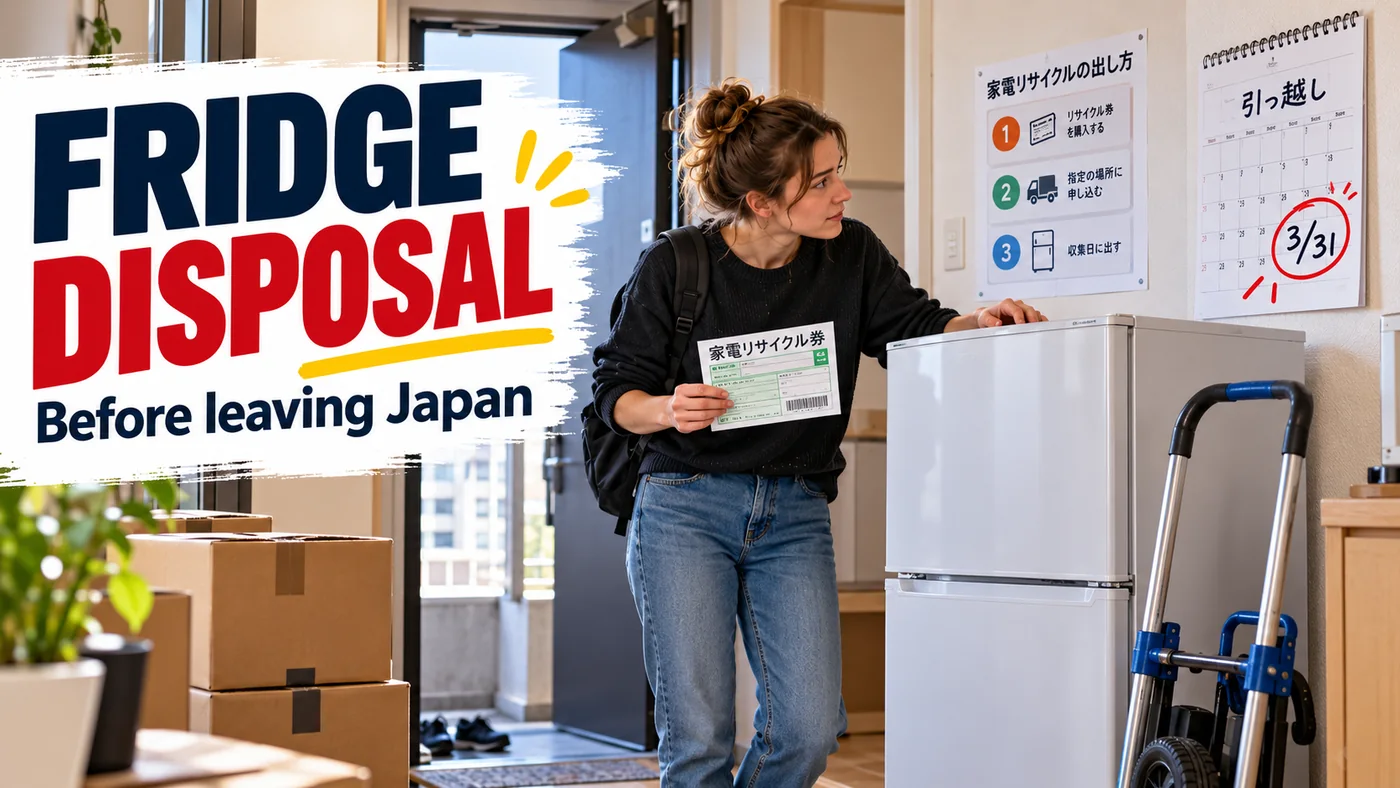
A refrigerator is the item that ruins many last-minute move-out plans. In Japan, household refrigerators and freezers are covered by the Home Appliance Recycling Law. They are not ordinary sodai gomi, and many municipalities will not collect them as bulky waste.
- The answer first: do not book ordinary bulky-waste pickup for a fridge
- Route A: ask the retailer when you know where the fridge came from
- Route B: if you do not know the original shop, follow your municipality’s instructions
- What information to prepare before you call
- If your flight is in three days
- Can you give the fridge away instead?
- Fridge disposal before leaving Japan: checklist
The answer first: do not book ordinary bulky-waste pickup for a fridge
The national Home Appliance Recycling Law covers four household-appliance groups: air conditioners, TVs, refrigerators/freezers, and washing machines/clothes dryers. The manufacturer recycles the appliance, while retailers and designated collection routes handle the handoff.
Route A: ask the retailer when you know where the fridge came from
National guidance says that when disposing of an appliance without buying a replacement, you should normally ask the retailer that originally sold it to take it back. If you are buying a replacement, the retailer selling the new appliance is the usual first contact.
Ask for the recycling fee, collection/transport fee, earliest collection date, and whether the appliance must be moved to the entrance.
Route B: if you do not know the original shop, follow your municipality’s instructions
If the original retailer is unknown or unavailable, national guidance tells residents to use the disposal method specified by their municipality.
Osaka City states that it does not collect or transport the four Home Appliance Recycling Law items. Its official page directs residents to retailer pickup or other recycling routes when the original store is unknown.
Sapporo likewise excludes refrigerators/freezers, washing machines/dryers, TVs and air conditioners from its municipal bulky-waste system.
What information to prepare before you call
- manufacturer name
- model number if visible
- approximate capacity/size
- your address and floor
- whether the building has an elevator
- the exact date the room must be empty
- whether you can carry the fridge outside yourself
A photo of the manufacturer label can save several messages because recycling fees can vary by maker and appliance category.
If your flight is in three days
Your priority changes from “cheapest possible method” to “a legal route that definitely finishes before handover.” Ask for the earliest available date and a written total including recycling and transport. If a private operator is involved, verify that the household-waste collection route is authorized for your municipality.
[mjhr_moveout_pr]
Can you give the fridge away instead?
Reuse can be practical when the fridge still works and someone can collect it before your deadline. But do not build your entire move-out plan around a stranger who may cancel. Set a cutoff: if the item is not collected by that date, switch to the disposal route while there is still time.
Fridge disposal before leaving Japan: checklist
1. Confirm that it is a household refrigerator/freezer covered by the recycling system.
2. Contact the original or replacement retailer when possible.
3. If that route is unavailable, use your municipality’s official instructions.
4. Get the collection date and total cost in writing.
5. Empty, defrost and clean the appliance before handoff if the collector instructs you to do so.
Leaving Japan soon? Use the full disposal decision guide →
Official sources: METI home-appliance recycling guide · Osaka City appliance-recycling instructions · Sapporo bulky-waste exclusions